Oil Painting and the Impasto Technique: Why Thickness Matters
There is a moment in painting when the brush stops being an instrument of depiction and becomes a tool of construction. This is the moment of impasto — when paint ceases to represent texture and becomes texture itself. For me, this is not a stylistic choice. It is a necessity.
What Impasto Technique Means in Practice
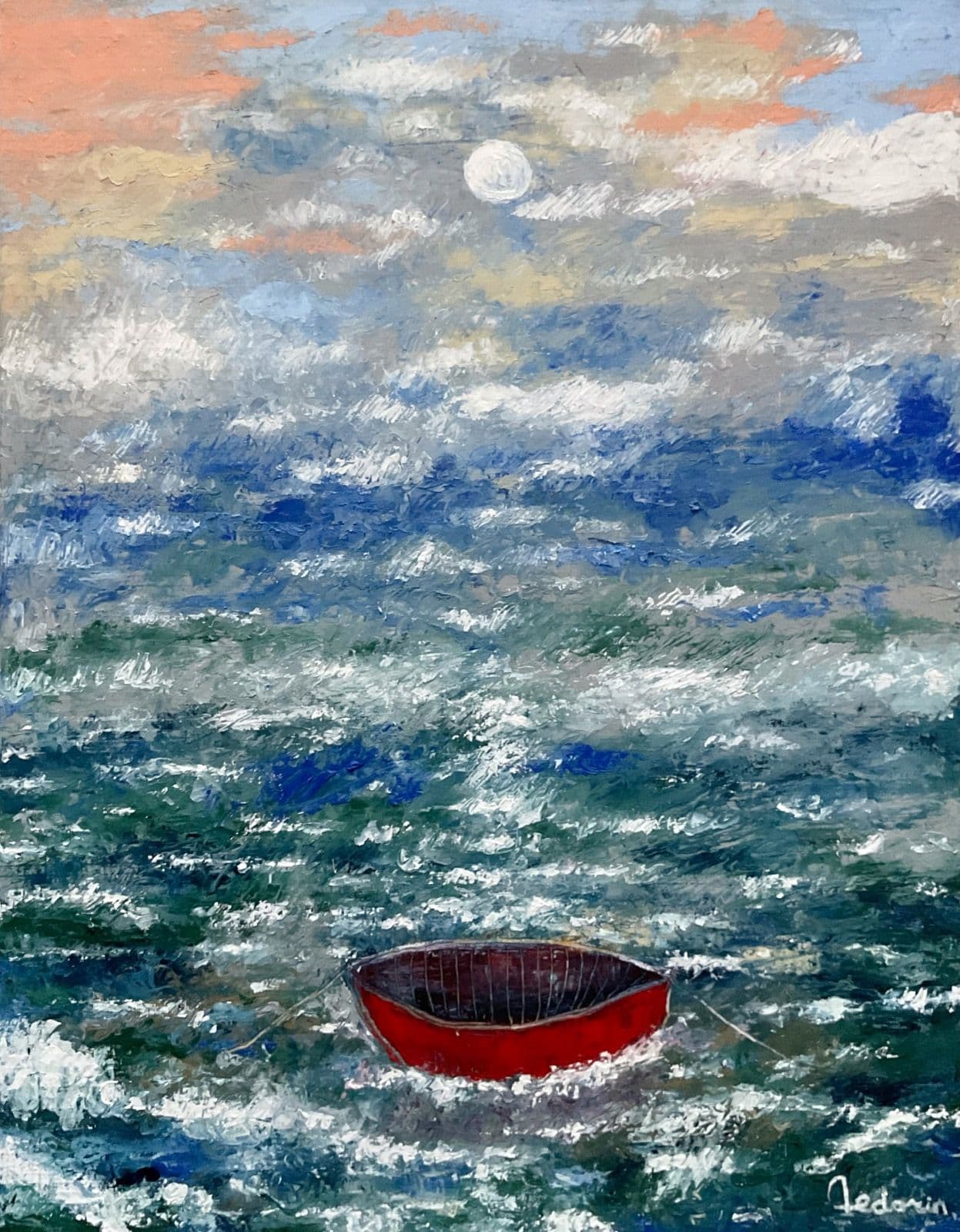
The impasto technique is the application of oil paint in layers thick enough to retain the marks of the brush or palette knife. The surface of the canvas becomes three-dimensional — ridges of pigment catch light differently depending on the angle, the time of day, the distance from which you look. A painting built with thick paint technique is never entirely the same twice.
In my landscapes — Harmonious Unity, Playa Reserva — the impasto is almost sculptural. The sea is not painted blue; it is built from overlapping strokes of blue, grey, green, and white that together create a surface as physical as the water itself. The oil painting texture becomes inseparable from the subject.
Building the Surface Layer by Layer
I work in stages. The first layers are thin, establishing the architecture of the composition. As the painting develops, the paint grows thicker — concentrated in areas of maximum intensity. A highlight on a wave, the crest of a horn, the pupil of a guardian's eye: these are the points where the impasto reaches its peak, where the painting pushes forward into the viewer's space.
This is why oil paint remains irreplaceable. No other medium has the same body, the same capacity to hold a mark permanently. Acrylic dries too fast, too flat. Oil breathes. It records time — the slow drying, the layering, the reworking. Every impasto stroke carries the memory of the hand that made it.
Texture as Meaning
The thick paint technique is not decoration. In my work, oil painting texture serves a philosophical purpose: it insists on the painting as a physical object, not a screen. In an age of digital images, a canvas that you can feel with your eyes — that changes as you move around it, that holds light in its ridges and shadow in its valleys — is a form of resistance. The painting asks you to be present. The impasto will not let you scroll past.